Saudi Arabia selects armed C-27J for anti-submarine and naval patrol role

February 17, 2026

Saudi Arabia has ordered four Leonardo C-27J Maritime Patrol Aircraft (MPA), extending the Kingdom’s growing Spartan fleet and giving the Royal Saudi Naval Forces a new fixed-wing capability for anti-submarine warfare, surface surveillance and search and rescue.
Deliveries are scheduled to begin in 2029.
With the deal, Saudi Arabia becomes the 21st operator of the C-27J globally, adding a dedicated maritime variant to an aircraft already in service across multiple air arms.
The order follows Riyadh’s in-country acquisition in summer 2025 of two C-27Js configured for firefighting, cargo transport and medical evacuation.
The latest contract marks a shift from utility and civil protection roles towards a fully militarised maritime configuration, and notably includes provision for the integration of maritime weapons systems, a first for the C-27J MPA variant.
Leonardo C-27J evolves into armed maritime patrol aircraft for Saudi Arabia
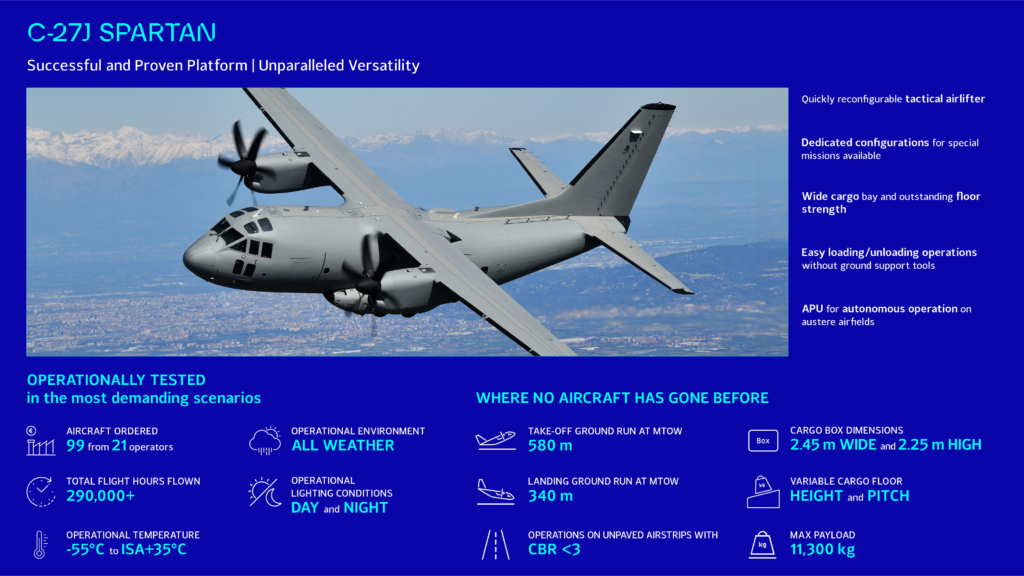
At its core, the MPA retains the baseline C-27J Spartan Next Generation airframe: a twin-engine tactical transport designed for short and semi-prepared runways, with a rear loading ramp and a cargo hold capable of rapid reconfiguration.
The Next Generation standard incorporates updated avionics, navigation and communications suites, identification systems and self-protection equipment, enabling operations in controlled civil airspace as well as contested environments.
The aircraft is cleared for operations in extreme climates, from sub-zero Arctic conditions to high-temperature desert deployments.

For maritime patrol duties, the Saudi aircraft will be fitted with a dedicated mission suite centred on Leonardo’s Airborne Tactical Observation and Surveillance system.
The architecture fuses data from sensors optimised to detect, classify and track surface vessels and submarines.
Real-time information can be shared with shore-based command centres and other units via secure communications links, including beyond line-of-sight connectivity.
Unlike earlier maritime configurations that focused primarily on surveillance, the Saudi aircraft will be equipped to carry a weapons payload tailored to mission requirements.
Options include lightweight torpedoes, anti-ship missiles and depth charges, enabling the platform to move from detection to engagement if required.
The ability to remove mission consoles and associated systems means the aircraft can revert to transport, airdrop or medical evacuation roles when needed. That dual-use flexibility remains a central selling point of the Spartan family.
Saudi Arabia expands C-27J Spartan fleet with naval variant
Leonardo’s relationship with Saudi Arabia extends beyond the C-27J. The company has long supplied rotorcraft for transport and rescue, maritime defence systems, electronic sensors and cybersecurity solutions.
A broader industrial cooperation framework signed earlier this year between Leonardo and Saudi authorities further underlined ambitions for deeper aerospace and defence collaboration.
The addition of a naval maritime patrol variant builds on that foundation while expanding the operational scope of the Spartan inside the Kingdom.

The Royal Saudi Naval Forces gain a medium-sized fixed-wing aircraft capable of persistent coastal surveillance, exclusive economic zone monitoring and anti-submarine screening in the Red Sea and Arabian Gulf.
For a navy tasked with protecting energy infrastructure, sea lines of communication and expanding offshore developments, the combination of surveillance sensors and optional strike capability offers a step up from rotary-wing assets alone.
C-27J Spartan global operators and maritime patrol roles
Globally, the C-27J fleet has accumulated more than 290,000 flight hours. The aircraft is in service in 17 countries across military and civil protection roles, with more than ten mission configurations developed to date.
The Spartan’s reconfigurable cabin, which is convertible in under 30 minutes, has allowed operators to adapt a single platform for transport, disaster response and surveillance.

The maritime patrol variant already serves with the United States Coast Guard, where it is used primarily for surveillance and law enforcement support.
The Saudi configuration, with integrated maritime weapons capability, signals an evolution towards a more heavily armed application.
Gulf maritime security drives demand for anti-submarine aircraft
The order comes amid sustained regional investment in maritime domain awareness and anti-submarine capability. Gulf states have expanded naval modernisation programmes in response to heightened undersea activity and the need to secure strategic chokepoints.
According to a Middle East defence expert, by selecting a platform that combines patrol endurance with transport flexibility, Saudi planners appear to be hedging against single-role specialisation. The aircraft can conduct maritime surveillance one day and humanitarian airlift or logistics support the next.
For Leonardo, the contract strengthens its presence in a market where industrial cooperation and long-term partnership are as significant as hardware sales.
The earlier acquisition of utility-configured C-27Js inside the Kingdom provided a foothold; the maritime order deepens it.
Deliveries beginning in 2029 place the aircraft’s entry into service at the end of the decade, aligning with broader naval expansion timelines.