Artemis II enters Day 5 as crew prepares for historic lunar flyby and far-side observations

April 6, 2026

NASA’s Artemis II mission has entered its fifth day in space, with astronauts now approaching one of the most anticipated phases of the journey: a close lunar flyby that will take them around the Moon’s far side for the first time since the Apollo era.
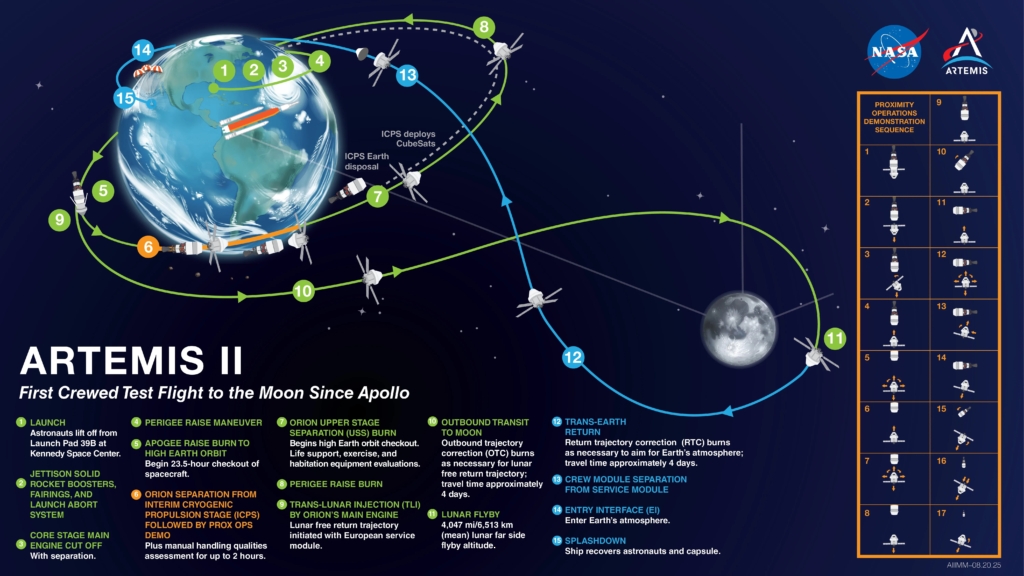
The mission, which launched on April 1 aboard the Orion spacecraft, is now deep in cislunar space and preparing for a carefully timed flyby on April 6 that will both shape their return trajectory and offer rare views of regions of the Moon never seen directly from Earth.
✅#Artemis II update: Day 5, Orion is moving at 1536 km/h, 356 379 km from Earth and 89 967 km from the Moon. One last look at Earth before arriving at the Moon (pic: NASA). See https://t.co/ui4ffrxn1q pic.twitter.com/ilgu3BE3H7
— European Space Agency (@esa) April 5, 2026
Artemis II lunar flyby to reveal Moon’s far side
The flyby is expected to unfold within a roughly six-hour window, when the Sun, Moon and spacecraft align to give optimal visibility of the lunar surface. During this phase, Orion will pass approximately 4,000 miles above the Moon, using its gravity to sling the crew back towards Earth.
At its peak, the spacecraft will reach a distance of about 252,760 miles from Earth, farther than any human has travelled before, surpassing the record set during the Apollo 13 mission.
Mission planners say the crew may be able to observe parts of the Moon’s far side with the unaided eye, an opportunity that scientists describe as both visually striking and scientifically valuable.
“We don’t know what to expect,” one NASA scientist said during a press briefing. “This is exploration, right?”
Artemis II prepares trajectory burn as crew targets key lunar observations
Ahead of the flyby, the crew is carrying out final preparations, including a planned outbound trajectory correction burn to refine Orion’s path.
Earlier in the mission, two such burns were cancelled after flight controllers determined the spacecraft was already on a precise trajectory.

Mission control has also transmitted a final list of 30 lunar targets for observation and imaging. Among them are the Orientale basin, a 600-mile-wide impact crater, and the Hertzsprung basin, offering contrasting geological features for study.
The crew will compare these formations to understand better how the lunar surface has evolved over billions of years.
Artemis II enters Moon’s sphere of influence in key deep space milestone
In the early hours of April 6, Orion entered the Moon’s “sphere of influence”, the region where lunar gravity becomes stronger than Earth’s, marking a major milestone in the mission.
At that point, the spacecraft was tens of thousands of miles from the Moon and more than 200,000 miles from Earth, continuing to gain distance as it prepares for its closest approach.
Make new friends, but keep the old.
— NASA (@NASA) April 6, 2026
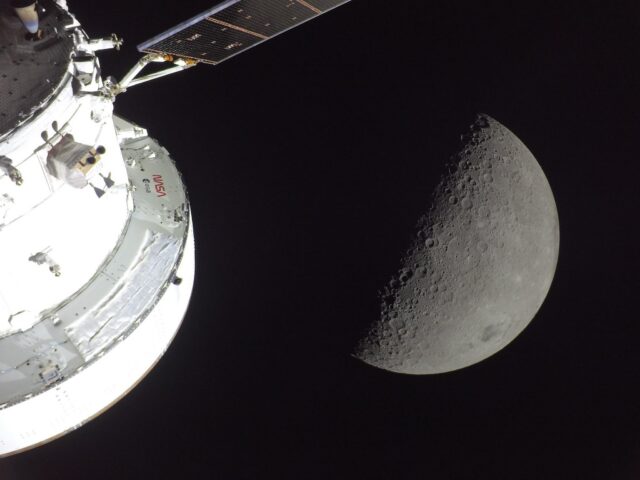
A new photo captures the Moon's near side on the right (the side we see from Earth, identifiable by its dark splotches) and its far side on the left. The Artemis II crew are the first to see the far side with human eyes. pic.twitter.com/Z8QaZ6J9iA
The mission, expected to last around 10 days, will see the crew travel a total of nearly 700,000 miles before splashdown off the coast of San Diego later this week.
Planned communications blackout will leave crew briefly cut off from Earth
One of the most striking moments of the flyby will come when Orion passes behind the Moon, triggering a planned communications blackout of around 40 minutes.
During this period, radio and laser signals linking the spacecraft to Earth will be blocked by the lunar body, leaving the astronauts temporarily out of contact with mission control.
Such blackouts are expected in lunar missions and were a defining feature of the Apollo era.
Mission control expects to regain contact shortly after Orion re-emerges from behind the Moon, resuming normal communications.
NASA officials have emphasised that the mission remains tightly constrained by life-support systems, particularly oxygen supply.
“As far as the 144-hour constraint that is tied to the oxygen and the ability to supply oxygen to the crew, those tanks are only so big, and they were sized for that contingency,” officials said during a press conference.
Engineers also confirmed that Orion’s cabin pressure will be reduced during the mission, a step designed to prepare for future docking operations.
“We are planning on decreasing the cabin pressure in Orion; that was always part of the plan,” officials said.
Artemis II crew continues spacesuit tests and onboard fixes
On Day 5, astronauts are continuing evaluations of the Orion Crew Survival System suits, conducting leak checks and testing mobility, as well as their ability to eat and drink while suited.
The suits are designed to protect the crew during high-risk phases of flight, including launch, re-entry and emergency scenarios.
At the same time, the astronauts are reviewing final procedures for the flyby and coordinating with mission control on observation techniques.
Alongside mission milestones, the crew has also dealt with practical challenges onboard.
NASA confirmed that Orion’s toilet system experienced a malfunction earlier in the mission due to a suspected blockage, likely caused by freezing.
“During the night, we attempted to vent the wastewater tank attached to the toilet, but encountered issues due to a suspected blockage, likely caused by ice,” Artemis II Flight Director Judd Frieling said.
Astronauts were temporarily required to use backup urine collection devices while engineers worked on a fix.
The issue was eventually resolved by rotating the spacecraft to allow sunlight to warm the system and clear the blockage.
What to expect during the NASA Artemis II lunar flyby
Key moments for the lunar flyby include the following. All times are Eastern and may change based on real-time operations:
Here's what to expect: pic.twitter.com/KcuQu8Qerl
— NASA Solar System (@NASASolarSystem) April 6, 2026
Monday, April 6
- 12:41 a.m.: Orion enters lunar sphere of influence at 41,072 miles from the Moon.
- 1:30 p.m.: The science officer in mission control will brief the crew on their science goals for the upcoming flyby. (NASA will host a conversation between the crew and the science officer in NASA’s Mission Control Center at the agency’s Johnson Space Center in Houston, to go over the objectives and timeline for the flyby. Because the Sun’s angle on the Moon shifts by about one degree every two hours, the crew could not know the exact lighting conditions to expect on the lunar surface until after launch. This briefing provides one final opportunity to review details before the flyby begins.)
- 1:56 p.m.: The Artemis II crew is expected surpass the record previously set by the Apollo 13 crew in 1970 for the farthest humans have ever traveled from Earth.
- 2:45 p.m.: Lunar observations begin.
- 6:44 p.m.: Mission control expects to temporarily lose communication with the crew as the Orion spacecraft passes behind the Moon.
- 6:45 p.m.: During “Earthset,” Earth will glide behind the Moon from Orion’s perspective.
- 7:02 p.m.: Orion reaches its closest approach to the Moon at 4,070 miles above the surface.
- 7:07 p.m.: Crew reach their maximum distance from Earth during the mission.
- 7:25 p.m.: “Earthrise” marks Earth coming back into view on the opposite edge of the Moon.
- 7:25 p.m.: NASA’s Mission Control Center should re -acquire communication with the astronauts.
- 8:35-9:32 p.m.: During a solar eclipse, the Sun will pass behind the Moon from the crew’s perspective.
- 9:20 p.m.: Lunar observations conclude.
Tuesday, April 7
- 1:25 p.m.: Orion exits the lunar sphere of influence at 41,072 miles from the Moon.
Featured image: NASA