Southwest Airlines sets limit of one power bank per passenger as lithium-battery fire concerns rise


Southwest Airlines will soon limit passengers to carrying just one portable charger per person, tightening its rules on lithium-ion batteries onboard, as airlines and regulators tackle a growing number of in-flight lithium-ion battery fires.
Southwest internal memo sets one power bank limit
As People reported, the new policy, distributed via an internal memo by Dave Hunt, Southwest’s Vice President of Safety and Security, will go into effect beginning April 20.
Under the updated rules, passengers may bring only one portable charger, which must remain accessible during the flight and cannot be stored in an overhead bin. Instead, the power bank must be kept on the passenger or in a personal item under the seat so that cabin crew can respond quickly if a battery overheats.

Southwest will also ban charging power banks using seat power outlets, where available, to prevent faulty lithium batteries from overheating during flights.
The airline stated the new policy aims “to strengthen our ability to contain and mitigate lithium battery incidents, including reducing the risk of battery fires,” as reported by Reuters.
The aviation industry has been contending with increased fire risks from lithium-powered devices, which have been linked to a growing number of smoke and overheating incidents on aircraft.
Lithium-ion battery thermal runaway risk intensifies
The lithium-ion batteries used in power banks, mobile phones, laptops, tablets, and many other electronic devices can enter a dangerous chain reaction known as thermal runaway. This reaction can produce intense heat, toxic smoke, or flames.
Because of the risk these batteries pose to flight safety, aviation safety regulators already require passengers to carry lithium batteries in the cabin, where crew can act quickly to contain the fire, and prohibit them in checked luggage.
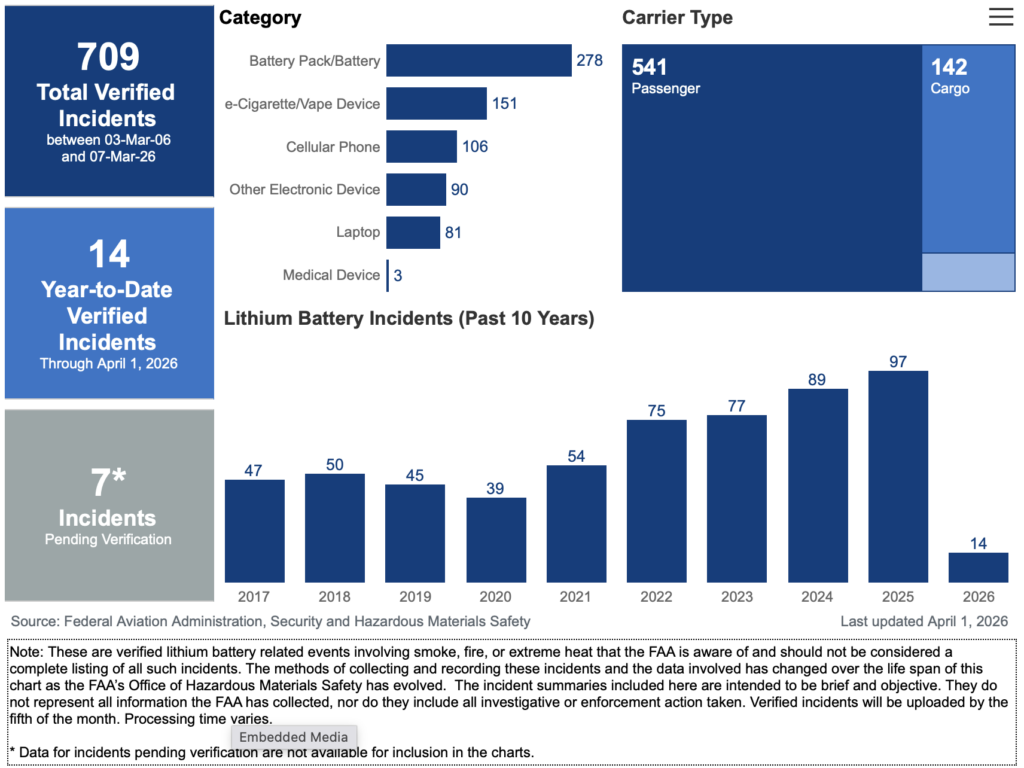
According to the Federal Aviation Administration, lithium battery incidents on aircraft have steadily increased in recent years, with a record-high 97 overheating or fire events linked to portable chargers and other electronic devices recorded last year.
Since the FAA began tracking incidents in 2006, it has recorded over 700 lithium-battery events involving smoke, fire, or extreme heat. The largest number of these (278) involved battery packs, such as portable chargers. Most incidents (541) occurred on passenger planes.
Airlines are tightening lithium battery rules
Portable chargers have become common travel accessories as passengers rely on smartphones, tablets, and laptops during flights. But the devices also contain high-energy lithium-ion cells that can ignite if damaged, defective or improperly handled.
Keeping batteries within reach of passengers and crew is considered a key safety measure because it allows cabin crews to quickly isolate overheating devices using fire-containment bags or water.

Airlines have already banned lithium batteries from checked baggage, following international safety guidance from the International Civil Aviation Organisation.
Southwest’s new restriction goes further than others, limiting passengers to a single power bank rather than the two-power-bank limit ICAO recommended in its policy update published this March.
Last year, Southwest was the first US airline to ban passengers from charging their electronic devices in their bags using power banks, requiring them to keep the devices and power source visible.
Southwest pushes in-seat power as it limits battery packs
Southwest has said it plans to introduce in-seat power outlets across its fleet by mid-2027, reducing the need for passengers to bring external battery packs during flights.
The airline, which operates an all-Boeing 737 fleet, has been gradually upgrading cabins with improved connectivity and charging options as passenger demand for in-flight device use continues to grow.
For travellers, the new Southwest rule requires a little planning ahead. Passengers should ensure their personal electronic devices are fully charged before boarding the aircraft, particularly on long flights where seat power may not be available.
Featured Image: Tomás Del Coro | Wikimedia Commons