


Air travel demand set to double by 2050, IATA forecasts

The International Air Transport Association (IATA) has published its air transport passenger demand projections, showing that air travel demand is on track to more than double over the next 25 years, reaching up to 21.9 trillion revenue passenger kilometres (RPKs) by 2050. RPKs measure overall traffic by combining passenger numbers with distance flown, reflecting the scale of airline activity.
The industry body’s latest Long-Term Demand Projections (LTDP) show continuing demand for air transport, despite a gradual slowdown in growth rates and the lasting impacts of the COVID-19 pandemic.
Air travel demand will grow from 9 trillion to over 20 trillion RPKs
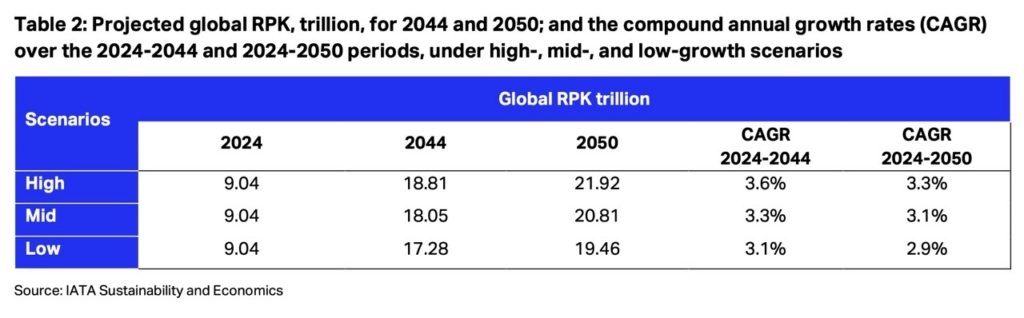
Global passenger demand, according to IATA’s mid-growth scenario, is expected to increase from 9 trillion RPKs in 2024 to 20.8 trillion by 2050, at a compound annual growth rate (CAGR) of 3.1%.
Under the two alternative scenarios:
- High growth: 3.3% CAGR → 21.9 trillion RPKs
- Low growth: 2.9% CAGR → 19.5 trillion RPKs
These projections rely on long-term assumptions tied to:
- Economic expansion
- Population growth
- Aviation fuel prices
- Energy transition pathways
- Air transport supply-side capacity development
“The outlook for air travel is positive… demand to fly is expected to more than double by mid-century,” said Willie Walsh, IATA’s Director General.
He said the projections underline the need for coordinated policy support, particularly around infrastructure, regulation, and the clean energy transition needed to sustain long-term growth.
Emerging markets will drive global air travel expansion
Air travel demand growth will not be even worldwide, as certain markets are already mature and will lag. IATA expects emerging aviation markets tied to developing economies to dominate the expansion of air travel over the next few decades.
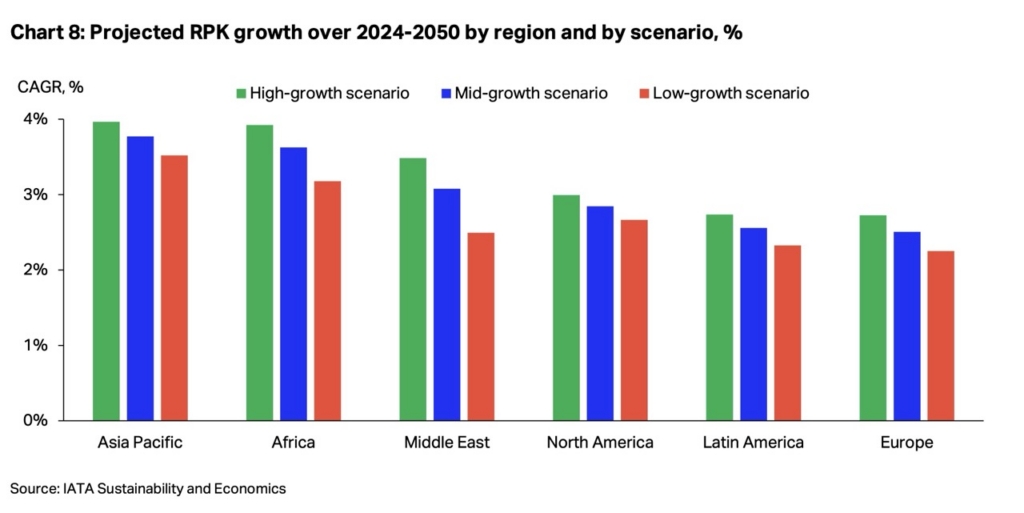
Under IATA’s mid-range scenario, the LTDP forecasts regional CAGRs as:
- Asia-Pacific: 3.8% CAGR
- Africa: 3.6% CAGR
- North America: 2.8% CAGR
- Europe: 2.5% CAGR
Some of the fastest-growing traffic flows include:
- Intra-Africa (4.9%)
- Africa–Asia Pacific (4.5%)
- Asia Pacific–Middle East (3.9%)
- Intra-Asia Pacific (3.9%)
- Africa–North America (3.8%)
European and North American markets will experience the slowest growth rates, reflecting both their maturity and slower population growth.
“The developed markets, such as intra-Europe and Europe-North America, are projected to have CAGRs at the lower end of the spectrum, at 2.0%-2.5%, with a slight exception for the intra-North America market at 2.6%-2.9%, due to stronger economic growth projections for the region,” IATA states in the LTDP report.
A lingering post-pandemic shift in commercial aviation growth
IATA’s analysis also confirms that the COVID-19 crisis created a permanent structural break in aviation demand.
“The pandemic caused an unprecedented collapse in demand, creating a structural gap that is not expected to close in any of our post-2024 recovery scenarios. Even under high-growth assumptions, the projected RPK growth through 2050 remains insufficient to converge with the pre-COVID GDP-aligned trend, illustrating the long-lasting scarring effect of the pandemic,” IATA states in the LTDP report.
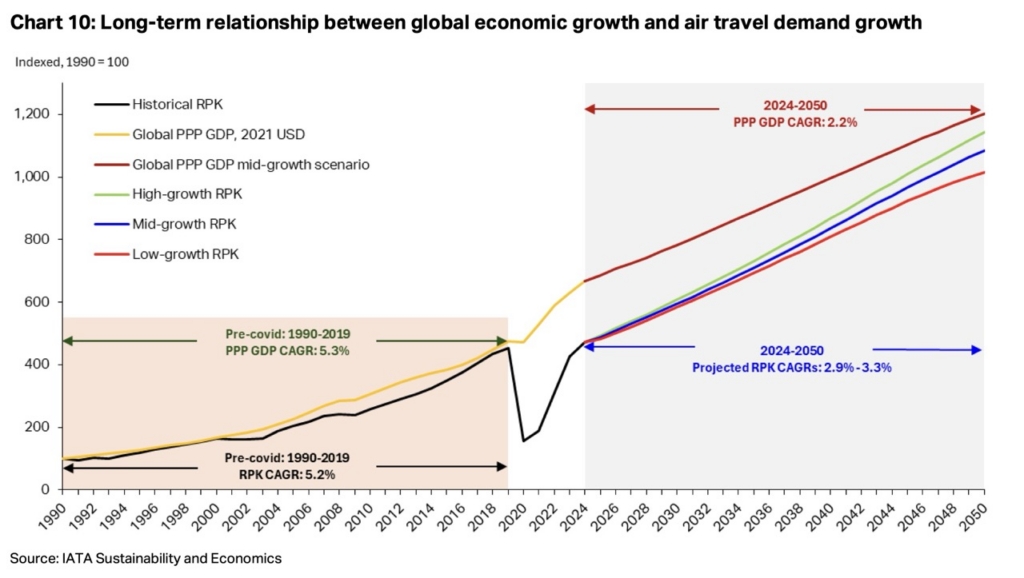
At the same time, the industry is entering a phase of moderate—but still robust—growth:
- 1972–1998: 6.1% CAGR
- 1998–2024: 4.5% CAGR
- 2024–2050 (forecast): 3.1% CAGR
This slowdown reflects market maturity, not declining demand, as total passenger numbers will continue to rise sharply in absolute terms.
The impact of projected airline growth on climate change
The projections highlight that, for policymakers and industry stakeholders, capacity and sustainability will direct aviation growth in the coming decades.
IATA warns that meeting demand will require:
- Major investment in airport and airspace infrastructure
- Improved market access and regulatory harmonisation
- Acceleration of the aviation energy transition, including sustainable aviation fuels (SAF)
The LTDP’s high-, mid-, and low-growth scenarios would yield very different climate change outcomes.
A high-growth scenario would miss the Paris Agreement net-zero targets
The high-growth scenario would have the most negative impact on climate change. It assumes the price of aviation fuel would decline over time. The airline industry would remain “almost entirely dependent on fossil fuels through 2050, and the carbon-based sources still comprise three-quarters of the global primary energy mix by mid-century,” according to the forecast.

A “business-as-usual” growth trajectory, while economically attractive in the short term, carries significant long-term risks for both aviation and the wider global economy.
IATA warns that a failure to accelerate decarbonisation would push global warming beyond 2°C, triggering escalating climate damage that could outweigh any near-term economic gains. By the end of the century, this could reduce global GDP by as much as 9%, ultimately weakening the very demand aviation depends on.
As the report states, this pathway “falls short of the Paris Agreement’s net zero targets” and risks leaving air transport exposed to the consequences of a significantly weakened global economy in the second half of the century.
A mid-growth scenario would meet net-zero targets, but relies on a ready supply of SAF
The mid-growth scenario would have a more positive climate outcome, aided by adequate scaling of sustainable aviation fuel production.
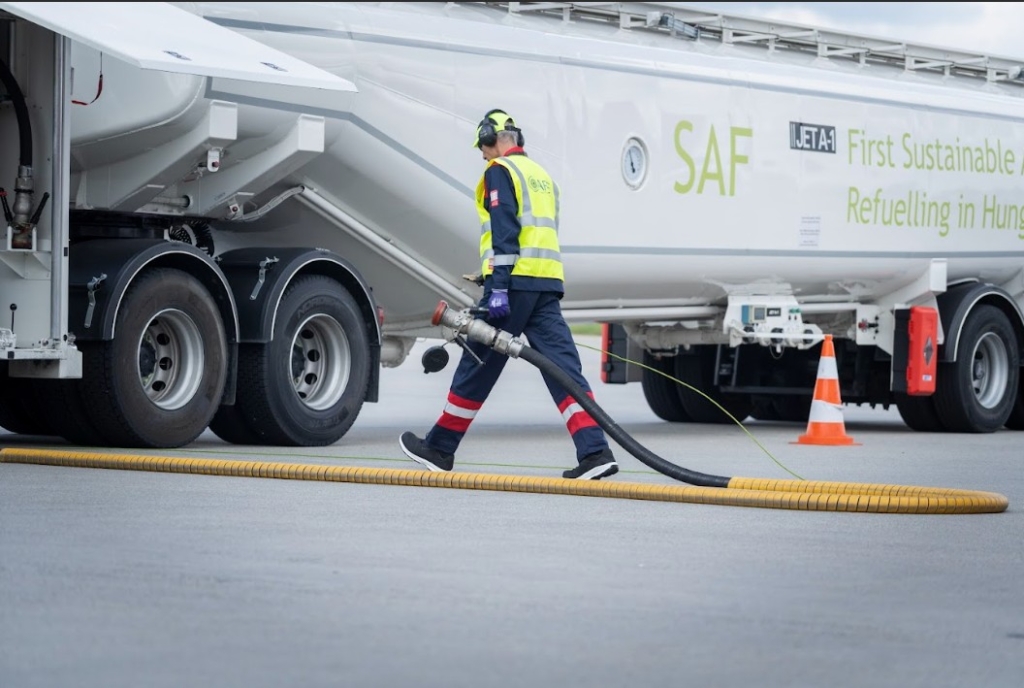
IATA’s mid-growth scenario presents a more balanced pathway, aligning aviation expansion with the Paris Agreement’s climate targets, but it comes with clear trade-offs.
The transition to lower-emission energy, particularly sustainable aviation fuels (SAF), would push fuel costs higher and weigh on economic growth in the short to medium term. However, the long-term outlook improves as avoided climate damage begins to deliver net economic benefits later in the century.
Crucially, this scenario depends on SAF production scaling in line with IATA’s Net Zero Roadmaps. Without that, the model begins to break down.
As the report notes, this pathway would limit global warming to around 1.6°C by 2100, but at the cost of slower infrastructure expansion, with airport capacity still growing, albeit at a reduced pace.
A low-growth scenario factors in a “disorderly” transition to SAF
The low-growth scenario reflects a more turbulent path to net zero, where delays in scaling SAF and other clean energy solutions lead to a more disruptive transition.
In this case, higher and more prolonged carbon abatement costs would weigh more heavily on global economic growth, while forcing more aggressive emissions reductions later in the timeline. For aviation, that translates into persistently high fuel prices and tighter capacity constraints.
IATA warns that under this “disorderly” transition, investment in airport infrastructure would be more limited, and demand growth would be increasingly restricted by supply-side pressures rather than passenger appetite.

In this sense, though the mid-growth projections are generally conservative, they are still optimistic given the current difficulties the industry faces in accessing adequate SAF supply.
Unless policymakers support scaling SAF production in line with IATA’s Net Zero Roadmaps, the industry is likely to face either a low-growth or a high-growth scenario, to the detriment of the climate.
The basis of IATA’s LTDP model
The LTDP model is based on a large-scale econometric dataset, incorporating:
- Over 500,000 data observations
- Around 41,000 country pairs
- Variables including GDP per capita (PPP-adjusted), population, employment, flight frequency, and aircraft size
According to IATA, the model has demonstrated 98% prediction accuracy, becoming a key planning tool for airlines, governments, and energy providers.
Aviation will keep growing because people and goods need to fly
Even as growth rates gradually ease, the long-term trajectory shows global aviation demand will surge well beyond today’s levels under all three projected scenarios.

Commercial aviation is essential to the global economy, supporting tourism and trade. While the growth rate of air travel has slowed in developed economies that have long relied on air transport, there remains significant future demand as other economies mature and grow.
For airlines and policymakers, the challenge for 2050 will be scaling the system to meet this demand sustainably.
Featured Image: xy | stock.adobe.com


